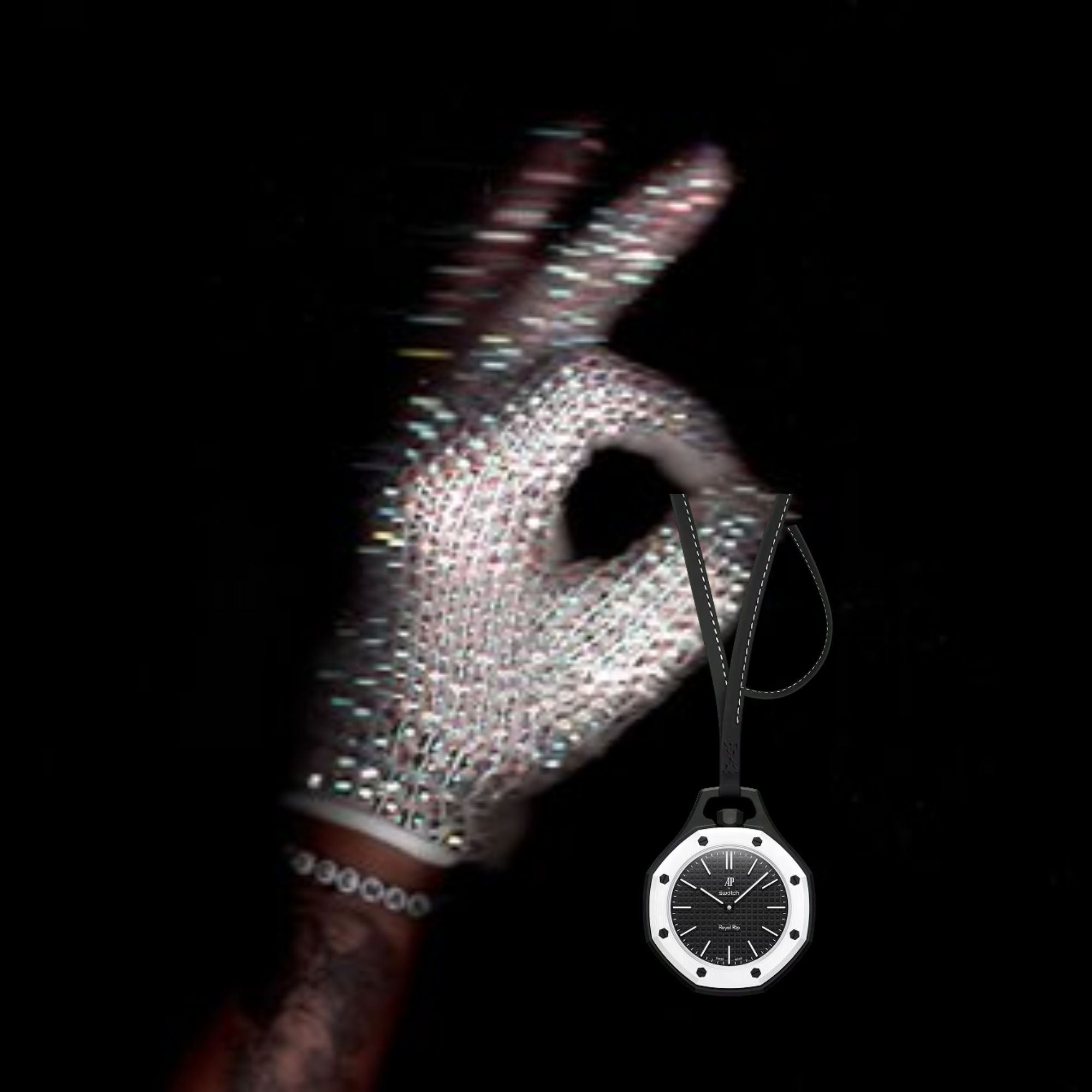
On May 14, 2026, Drake unveiled the cover art for ICEMAN: a rhinestone-encrusted glove throwing his signature “6.” Within 24 hours, it had become a marketing template for major brands, organic promotion that would have cost tens of millions in paid distribution.
Two days later, Audemars Piguet, a 151-year-old Swiss watchmaker whose 1920s pocket watch sold at Sotheby’s last December for $7.7M, released a $400 pocket watch with Swatch. Lines formed from Paris to Dallas. Some stores delayed the release over safety concerns.
Different industries. Different audiences. Both generated more earned media in 72 hours than a Fortune 500 marketing budget buys in a year.
How? Culture-Market-Fit
Core Observations of Memes, Mimetic Desire, and Consumption
- David Deutsch, in The Beginning of Infinity, describes memes as units of knowledge that survive by causing their holders to propagate them. Products compete in the same evolutionary environment. Products get replicated (shared / purchased) only if they encode knowledge (value) hosts (customers) find worth carrying.
- René Girard describes mimetic desire: we do not want things because we independently value them. We want them because someone we admire, or a group we want to belong to, wants them.
- Veblen coined conspicuous consumption: buying expensive things to signal wealth. The modern version is conspicuous reference: you signal status by displaying fluency with the references your in-group recognizes.
Address these together and you arrive at Culture-Market Fit.
Product-Market Fit (PMF) tells you whether the product works for the user who buys it. Culture-Market Fit tells you whether the product “travels”, whether it gets picked up, remixed, and re-shared by communities beyond the ones identified in your marketing deck, communities you do not control and cannot pay.
Distribution is saturated and attention is scarce. PMF is necessary but on its own no longer sufficient. The gating factor is whether your product is a “meme” worth sharing. Product-Market Fit is passive: accumulated trust priced into your SKU. Culture-Market Fit is active: the live capacity to ship product that is replicative. It cuts deeper because it touches the identity of your customer.
There are two ways to build Culture-Market Fit.
1. Ship product targeted to subculture(s).
Find a community, outside your perceived demographics, whose rules you understand and ship a product designed to plant a flag inside it. Every detail: references, price, comms, aesthetic, aligns with the in-group’s vernacular. You lend a piece of your IP so the subculture claims your product as one of their own. Marketing to a subculture without building for one gets your product rejected as tourism or appropriation.
To do this you need people on your team who are embedded. Taste is forged in subcultures with an instinct to sniff out imposters. Not following the scene on Instagram. Not the youngest person in the room who can run social media. Embedded.
This is what Audemars Piguet did. AP had every reason to sit on heritage forever. Instead, they shipped into the reseller-meets-collector-meets-hypebeast cohort primed by the MoonSwatch collab, a precedent they had watched de-risk for four years. The Royal Oak’s octagonal bezel was retained but remixed. The calfskin lanyard invited obvious comparisons to Labubu (the bag-charm moment AP clearly understood). The Swatch partnership gave them residency and logistical reach in a community they could not have entered alone. Multiple subcultures outside the watch community claimed the Royal Pop moment and shared (propagated) it for free.
2. Ship artifacts subcultures can remix.
The inverse. You ship an artifact so primed for and filled with references that multiple communities claim it simultaneously. The asset becomes a substrate others build on. You lose narrative control, but every remix is free distribution into a community you could not have bought your way into.
This is what Drake did with the ICEMAN rollout and cover. The cover is both promotion for the music and the propagation engine. The simple, almost fill-in-the-blank template inspires “memeability” by design. Drake has architected his rollouts this way for a decade (from Views to CLB), the visual language always under-determined enough that anyone can drop in their own context.
The deeper question is why brands co-opted the cover within 24 hours. A Drake album is a cultural eclipse: for 72 hours, a disproportionate share of global attention points at one artifact, and brands cannot afford to be outside the conversation. Remixing the cover is proof that someone inside your company is “plugged into the culture” in real time. The artifact gives brands permission to participate without paying Drake a dollar; Drake gets free distribution into hundreds of communities he could never have bought. Both sides win.
So, what to do?
If you are building a company, ask which specific subcultures your product is designed for but not currently addressing, and who on your team is actually embedded inside them. If no one is, find those people.
If you are investing, the Culture-Market Fit questions: what does the product let people signal to their in-group? What is the most recent “meme-able” artifact this team or organization has shipped? How fast can they move when a cultural moment opens?
For all of us, especially those worried about the AI-fication of society, develop taste through participation, not consumption. Build standing in a scene you care about, no matter how big or small, slowly, over years. Expertise in your subculture is invaluable. Be embedded somewhere real.
You cannot buy real virality. You cannot fundraise it. You cannot prompt-engineer it. You must identify your Culture-Market Fit. You must be entrenched in subcultures long enough to move with the cultural moment. Simply put, if you’re reading about it, it’s too late.
 Joshua Nyangon